No-Bake Vanilla Bean Cheesecake For One with Black Sesame Brittle

Sweet, tangy vanilla cheesecake with a crumbly crust, topped with shards of black sesame brittle. 

So much goodness in a 4-inch tart pan. The addition of black sesame? Almost unprecedented, perfect.

A few days ago I had the pleasure of attacking a bought cheesecake in a jar, with a delightful crumbly crust, topped nicely with passionfruit. The first bite made me realise, and later lament, how much I adore cheesecake sometimes. It was my favourite sort of cake thing aged 5 upwards; hot, cold, plain or with something swirled in, I liked it all. The addiction pash waned a few years ago, but recent encounters with good, solid cheesecakes rekindled that familiar joy and pleasure.

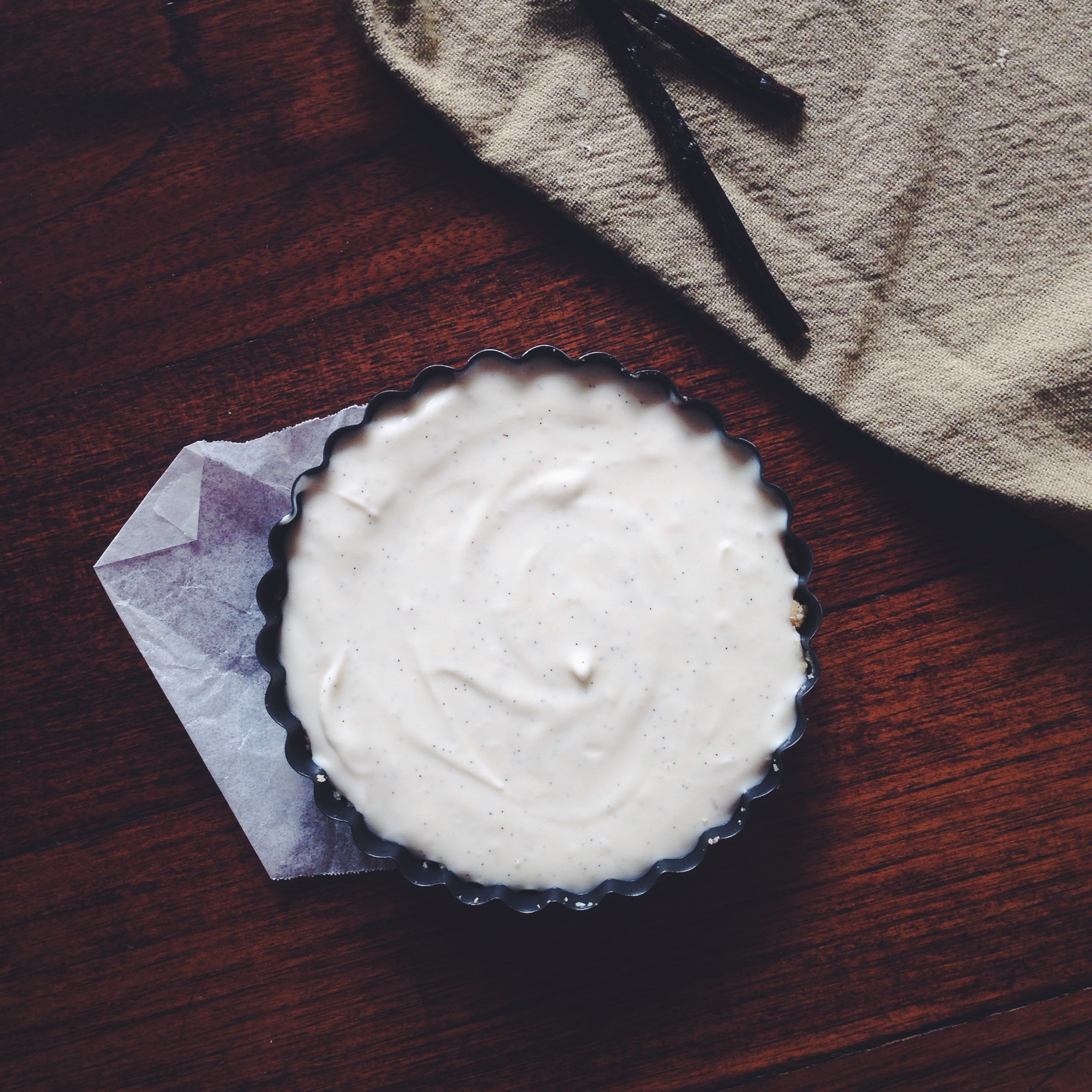
Ah, speckles.

What I love about this is that it’s totally customisable, depending on the ingredients you have in stock. Save for the main component of cream cheese, of course. You see, the main base is cream cheese and icing sugar, but the ‘lightening’ components are needed for lift, volume and better distribution of flavours. Now these can be altered. I state whipped coconut cream as one component, but not many people have a can of coconut milk or cream lying around, so whipped cream (or whipped topping) would work just as well. A milder flavour suits the majority, too. And the vanilla bean? Well, life doesn’t end here. Vanilla extract would work as well, but if you’re the sort who doesn’t like to compromise on taste and scent, I strongly suggest going all out, and remember that these beans will always come in handy, for instance in your sugar and in a myriad desserts.
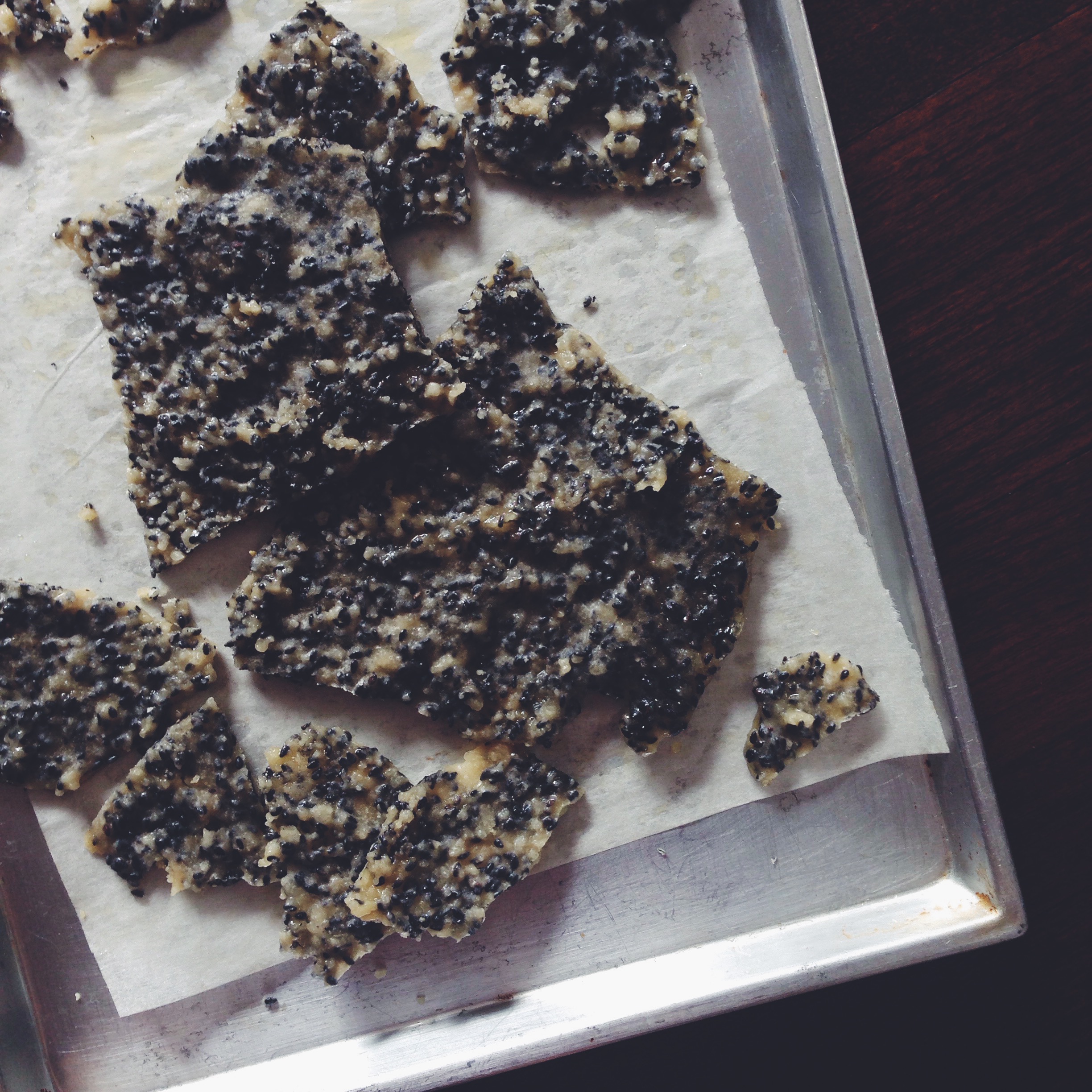
Vanilla bean and black sesame work like a dream together. The latter component is optional, but to spoon a bit of cheesecake onto a small shard of crisp, sweet brittle? Joie de vivre. The actual process of making the brittle isn’t half as hard as it sounds. I know, words like ‘brittle’ might as well be replaced with ‘croissant lamination’ or ‘flambée’. But the only hard thing about this is waiting, and perhaps spreading the brittle into a thin enough layer before it hardens completely. On a side note, things like sesame and flax have compounds called lignans which help to regulate metabolism and weight, and that’s always a plus, right?

No-Bake Cheesecake For One With Black Sesame Brittle

Ingredients

For the cheesecake:

25g biscuits (I used Nice biscuits, but you can use graham crackers/ oreo cookies/ anything you have on hand)

10g melted butter

70g cream cheese, at room temperature

20g icing sugar (no need to sift)

1 heaping tbsp nut butter such as peanut butter or almond butter/ tahini (I used tahini)

2 tbsp whipped coconut cream/ whipped cream

the insides of half a vanilla bean or 1/2 tsp vanilla extract

pinch of salt

For the black sesame brittle:

200g (1 cup) white sugar

60ml (1/4 cup) water

4 tbsp black sesame seeds

30g (2 tbsp) unsalted butter

pinch salt

Directions

If you’re using coconut cream in your cheesecake base, then start prep the night before. Take a can of coconut milk/coconut cream (the label can be either) and place in the fridge overnight. The next morning you should have a thick, firm white cream. If you’re using normal whipped cream, whip up a batch the night before and let set in the fridge so it’s more stiff the next morning when ready to use.

Place your biscuits in a small ziploc bag and zip the top tightly. Take a rolling pin and bash the biscuits until you get fine crumbs. Pour in the melted butter and incorporate well with your fingers (on the outside of the ziploc bag, of course). Pour into a small tart (should be 3-4 inches wide), or a small jar/cup, and press into an even layer with your fingers. In a medium bowl and with a metal whisk, whisk together all the ingredients listed above needed for the cheesecake.  The bowl needn’t be anything larger than medium since there’s not much volume to work with anyway (hoorah for a cheesecake all to yourself!!). Scrape the mix into your tart/jar/cup and place in the fridge to firm up. It’s ready for consumption in just 30 minutes, but you can eat it whenever.

Black sesame brittle? Easier than it sounds. I based the recipe off Joanne Chang’s Flour recipe for cacao nib brittle, and though I would have preferred a thinner, lacier texture, this still worked fine by me and the rest of my family. Grease and line a large baking sheet and set aside (the top of the baking sheet should be well greased too). In a medium saucepan, add the sugar and water. Place on high heat and let come to a hard boil. Let the mixture continue to boil for 5-8 minutes, or until you get a light brown colour. At this point, pour in the black sesame seeds and swirl pan in a circular motion to distribute, or do so gently with a wooden spoon. Let mixture continue to boil until the colour deepens to a deeper, richer amber-gold colour. Then, whisk in the butter and salt. Take off the heat and pour onto the baking sheet and spread into a thin layer with a spatula or wooden spoon. Work quickly because the mixture hardens with time. A couple of minutes later you can break the layer of black sesame brittle into shards, or pieces as big or small as you like.

Stick shards into the cheesecake and eat both components together. I like to spoon the cheesecake onto the sharp, sweet bits chockfull of black sesame seeds. YUM.

Chocolate Chip Buttermilk Pancakes

In other words, sin.

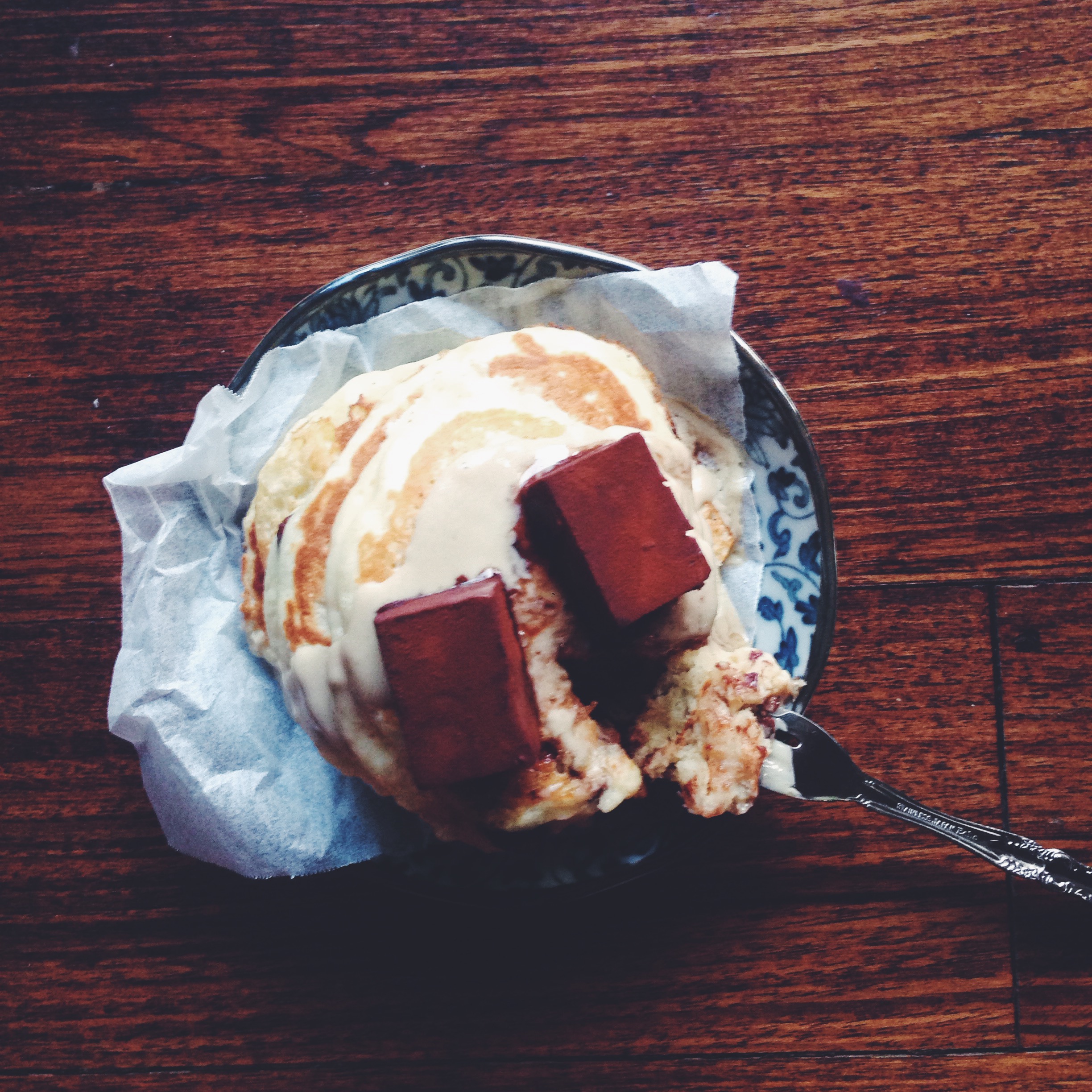
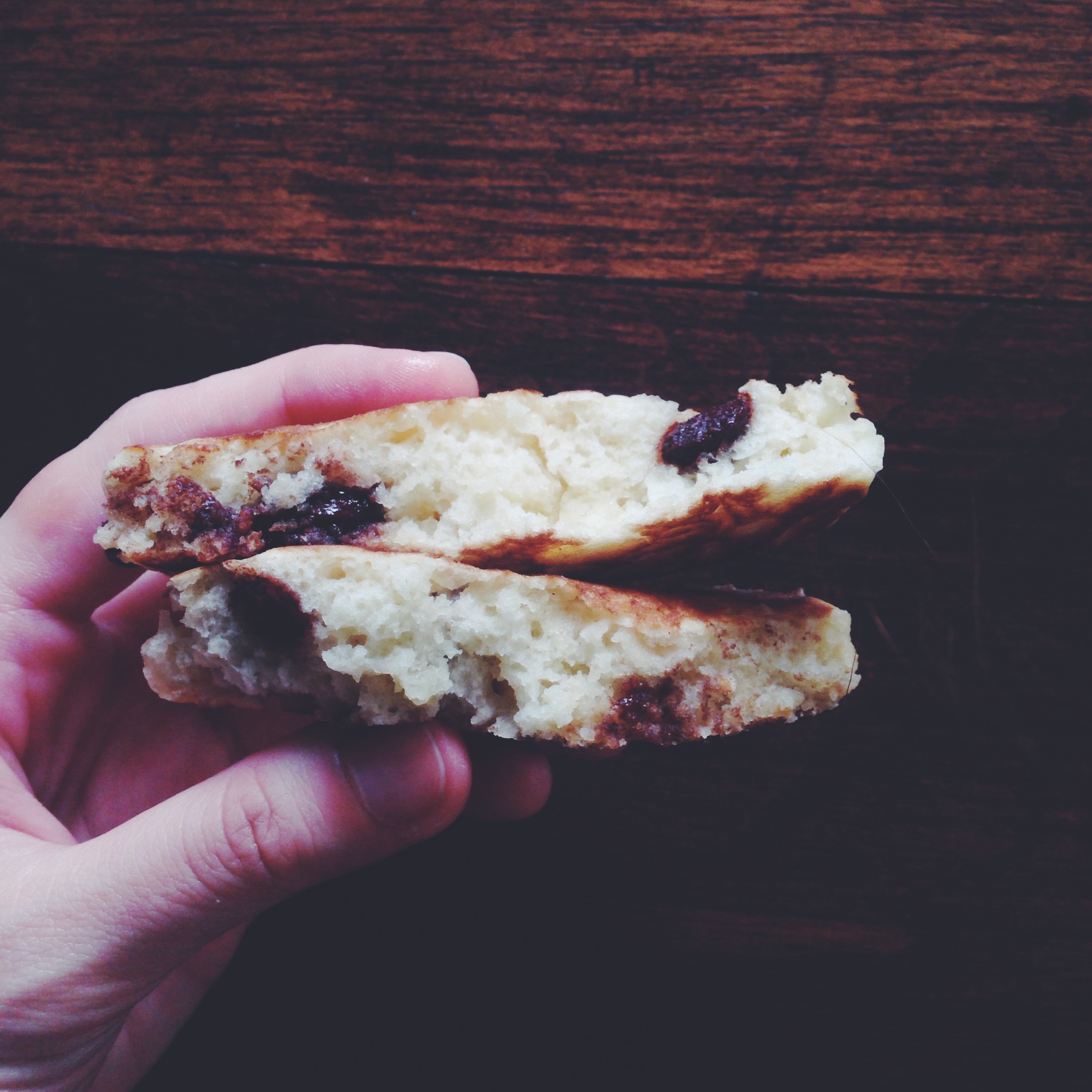
Pockets of sweet fudge, buttery, mildly sweet batter, the familiar mosaic on each side of a perfectly cooked, risen pancake.

Each forkful is effortless, tender.

Can’t wait any more. I know I have a well-stashed ‘Babbles’ category, but sometimes there’s no time for babbling. Especially with as straightforward and delicious a recipe like this. Stocked the praise in the main post which you can find in the directions below, but I felt the need to dedicate a separate post to this chocolate version. Ugh, stuffed silly with chocolate. You can’t not like chocolate. Or these. On a Sunday, with the birds chirping and the world is glistening.

Directions

Make the pancakes according to the instructions in my previous post for my favourite buttermilk pancakes herebut add 85g (a large handful) of chocolate chips (I love Ghirardelli’s or Nestle’s mini milk or semi-sweet chips for this, which make for the perfect little pockets of goo) to the dry mix before adding the wet mix.

And that’s it! Top with maple syrup or whatever you want. I added tahini for a slight savoury, creamy punch. You don’t need much when chocolate’s in the picture.

Make This Oatmeal Now (updated recipe with a twist)

I thought I had it all figured out, given the number of times I’ve made oatmeal in my life. Overnight, hot, cold, lukewarm (ew), apple-pied, black sesame-ed, peanut buttered, I’ve done it all. I even wrote a post about it here exactly a year ago, yet I only just discovered what I think is the perfect method for making the thickest, creamiest oatmeal ever. Trial and error does pay off sometimes. It’s more reliable, oats coming out perfect every time. Mind you, this method is preferable is you like the super thick and gloopy sort, but even if you don’t, you just have to take your oats out of the microwave a little earlier.

Catch– it involves the microwave. I can hear the disappointed sighs. They’re boring into the screen already, reaching me, slaps in the making.

I get it, I do. I used to think the only way to achieve the perfect, creamy consistency for oats is to do it the proper and old-fashioned stovetop way. The whole process just makes more sense, it wants you to feel like you’re doing it the better way, doesn’t it?

Funnily enough, this microwave method not only yielded the most desirable consistency, it also seemed to enhanced the flavour of mashed banana, the one ingredient I always put in before cooking my oats for added sweetness and creaminess.

No wait. Just do.

Directions 

The night before, mix together a half cup of rolled oats, half cup of water, half a mashed banana, and a half cup of milk of choice (I always use a mix of whole and almond) in a relatively large, microwave-safe bowl (because this mixture will se. Leave this in the fridge overnight.

The next morning, put your bowl in the microwave and microwave on high for 2 minutes. Take a spoon and mix, then put in the microwave for another minute. At this point, your oatmeal should be noticeably more voluminous and thickened, depending on the power setting of your microwave. Microwave in 30-second increments until you have oatmeal that seems to have more than doubled in volume. Just check your oatmeal every 30 seconds, mixing well between each spurt of heating. Err on the side of caution here.

And you’re done! At this point, you can add whatever you want. My standard toppings are more banana, a heaping tablespoon of almond butter (cashew/peanut/almond), blueberries for a nice tang to cut through the sweet goop, and plenty of honey or maple syrup. Once the oatmeal is a little cooler, I also add a dash of cold, whole milk.

BUT. In this case, I highly recommend trying out this kaya and coconut twist. It’s the sort of combination I’ll be coming back to again and again, for the flavours are close to my heart and it’s a nice break from your typical snack of kaya and butter toast!

The Twist

You should now have a thick, creamy, voluminous mass in your hands. Take the other half or a whole banana and slice it down the middle. Butter a hot pan and fry the banana on both sides. Place the caramelised banana on top of the oats, then add a heaping tablespoon each of almond butter and kaya (I love Breadtalk or Yakun, and my grandma makes a mean one too), a generous drizzle of maple syrup, coconut flakes and a dash of whole milk. Mix everything together, admire the glorious mess, then tuck in happily.

Coffee and Kaya Yeasted Doughnuts

Yeasted doughnuts filled with kaya and drizzled with a strong coffee glaze. 

A tribute to one of my all-time favourite morning traditions.

In other words– butter, kaya, bread and coffee. It doesn’t get any better, or simpler, than that. Sometimes it’s butter and honey, or butter and jam, but most of the time it’s butter and kaya. It’s really common here in Singapore, where you eat butter-kaya (a pandan-flavoured spread) toast from Yakun or some hawker stall with soft-boiled eggs, all downed with smooth, creamy kopi (local coffee made with condensed milk, AKA the best drink ever alongside teh halia… ok and maybe Coke). Yes, I’m talking processed white toast, pre-cut and plasticky; sometimes I get the fancy sort from the bakery if I feel like it, but usually it’s just that and not much more. The sort of bread you would squeeze and press with glee as a kid because the degree of artificiality pretty much makes it more playdoh than bread, and I know you know what I’m talking about.

Toast.

Let the Nespresso machine kick into gear. Slather two almost-burnt slices toast with salted butter, because I like my toast that way and because salty butter is a must in my morning regime. Anything else and I feel that I’m cheating myself of flavour. Salty and sweet forever, unless I’m baking, in which case I always stick with unsalted butter and add the salt myself.

(Yes, they were spread further away from each other after this shot.)

This recipe represents this magical, true-to-local-taste flavour combination. Doughnut form. I’ve been itching to make yeasted, fried doughnuts for quite a while now, and when I got my hands on Baking Illustrated, with all the recipes tested and compiled by America’s Test Kitchen, I couldn’t wait to try their version of it. After 2 trials, a bit of tearful upsets and a lot of joyous finger-licking, I think I fell in love with the fluff and harmony of the final product. Their recipe advocates the use of vegeetable shortening instead of normal vegetable oil, and although they state that Crisco (veg shortening) yields the best result, I used canola oil in the second trial and couldn’t detect any distinct change in flavour or texture, so I doubt the change would produce a drastic difference if you used either.

This was my first time making fried doughnuts, but definitely not my last. There’s a certain ecstasy involved in replicating something so ubiquitous, yet undeniably delicious. Perhaps I’ll test the recipe again with a different flavour combination, or just anything that involves a delirious sprinkling of icing sugar after everything is done and dusted.

Coffee and Kaya Yeasted Doughnuts (makes around 16 doughnuts, adapted from Bakers Illustrated)

Ingredients

For the doughnuts:

450g (around 3 cups) all-purpose flour

2 1/4 tsp (1 envelope) instant yeast

6 tbsp white sugar

1/2 tsp salt

160ml (2/3 cup) whole milk at room temperature

2 eggs, at room temperature

85g unsalted butter, at room temperature

1.1 litres (6 cups) vegetable shortening like Crisco, or vegetable oil

For the filling and glaze:

1 cup (or more) of kaya, homemade or store-bought

4 tbsp freshly brewed espresso

160g icing sugar

Directions

In a medium bowl, whisk together the flour, sugar, salt and instant yeast. Set aside for the time being. In your large mixing bowl fitted with a standard dough hook, mix together the eggs and milk. You could do this in another bowl if you don’t have a stand mixer such as a KitchenAid, just make sure the bowl is larger than the one in which you put the flour, and you will have to knead the dough for a little longer later in the process.

After mixing the milk and eggs, add the flour. Mix on low speed with the dough hook until you see a ball of dough forming. At this point, take your butter and add it in 4-5 additions, mixing well into the dough between each addition. The butter should be soft, not cold and hard, to make the process easier and faster. After all the butter has been added, mix the dough for another 3 minutes. If you’re doing this by hand, knead the dough for around the same time or longer, until you get a soft, plump and pale ball of dough. Have extra flour on hand in case you need more; you should have a soft but firm ball. Not too sticky, but not too firm, either. Shape your ball (remove the slightly stickier bits from the dough hook first) into a ball if it’s not like that already, then place back in the bowl, cover with a towel and let rise until doubled, around 2 hours. It should be visibly voluminous when you come back to check on it later.

After 2 hours, check on the dough– press lightly with a finger, it should feel tender but still quite firm. If not, leave for another 15 minutes. When ready, flour your work surface and tip your ball onto the counter. Take your rolling pin and flour that too, to prevent it sticking to the dough. Roll the dough out until it’s around 3/4 of an inch thick. Take a 3-inch wide circular cutter (or in my case, a scallop-edged one because I was feeling odd) and cut out circles of dough. Take the scraps left over and re-roll, then cut more circles. Place your doughnut circles onto a floured baking sheet and let rise for a half-hour more.

In the meantime, heat up your oil in a deep and wide sauce pan, or large Dutch oven. Prepare another sheet that’s lined with paper towel, so you won’t get an oily counter afterwards. Stick a candy thermometer by the side of the pan and let it heat up until 375F, or 191C. Take your risen doughnut cut-outs and place gently using a spatula or large slotted spoon into the simmering oil, 4 or 5 at a time. Wait 20 seconds for the first side, then flip to fry the other side, which will take another 20 seconds. They will be golden-brown, puffy and all moreish-looking. Place the fried doughnuts onto the paper towel. Repeat until all doughnuts are fried. Let them cool on the paper towels for at least 15 minutes before filling.

To fill, place the kaya in a piping bag, or into a large ziploc bag and cut off one corner just before filling. If using the piping bag, insert the nozzle into the side of a doughnut, and then pipe until full; the kaya will leak a little around the side if you pipe too much, too fast. If using the ziploc bag, use a knife to make a small incision at the side, before inserting the corner of the bag into the side and piping until full. To make the glaze, mix together the freshly brewed espresso and icing sugar. Dip the tops of the doughnuts into the glaze and let some drizzle down the sides. Sprinkle with chocolate curls before eating immediately, or at least on the same day.

Keep these doughnuts at room temperature for up to 2 days, else they just won’t taste fresh!

Red Velvet Cake Bars

IMG_5558

Truly no frills.

And way too hard to mess up, to be perfectly honest. There are a few reasons why I’m in love with this red velvet cake recipe. Why? A list seems appropriate, yes. These cake bars (or mini circular-sort cakes, if you would like, those work too) are:

  1. The most moist, fluffy and tender red velvet cake bars your lips will ever meet.
  2. Have a deeper chocolate flavour than most red velvet cake recipes
  3. Have actual melted chocolate in the batter (!!)
  4. Cream cheese frosting. That is all.
  5. Thick, creamy, vanilla bean-ified frosting.
  6. Frosting.

Red velvet has gotten quite a bit of flak recently. Most everyone has tried these dainty red cakes slathered in cream cheese frosting. However, due to its perceived nature of artificiality and lack of distinct flavour thanks to too many a sticky-topped, mass-produced factory version, people have come to believe the one true hero of the eponymous red velvet is really just that cream cheese frosting… and not much else. If I may quote someone from my favourite TV series– red velvet is a lie!

The chocolate notes have been forgotten, abandoned, and what was once known (I remember the trend hitting hard around 2-3 years ago) for unbeatable moistness and tenderness has been passed off as that unnecessary trendy thing with too much red food dye. 

With this recipe, hopes have been revived.

IMG_5573

I found it in my mother’s huge collection of cake recipes (quite literally a huge grey file labelled ‘CAKES’), and modified it to taste and texture. The red velvet batter has the perfect hint of chocolate, and the cream cheese frosting is rich, cram-jammed with real vanilla bean and the right amount of tang. I could go on about this cake and how easy it is, but I don’t think I need to bore you with the details. Let’s get to it, because life is short and there’s no point wasting time wasting time.

Ingredients (makes enough for 3 batches of cake bars in an 8×8-inch pan, or 3 6-inch cake layers)

For the cake bars:

120g soft, unsalted butter

330g castor sugar

300g all-purpose flour

2 eggs

50g cocoa powder

1 heaped tablespoon red gel food colouring

1 tbsp vanilla bean paste (or substitute with the same amount of vanilla extract)

50g bittersweet chocolate, chopped (preferably from a bar, but chips are fine here too) and melted in 30-second increments in a microwave

250ml buttermilk (or mix 240ml whole milk with one tablespoon of white vinegar, and leave to rest for a while before using– the mixture should be slightly curdled)

pinch of salt

2 tbsp white vinegar

1 1/2 tsp baking soda (bicarb soda)

For the cream cheese frosting (enough for the tops of 3 batches; make double this amount if you wish to frost the sides as well):

42g unsalted butter, at room temperature

1 tsp vanilla bean paste (or sub with vanilla extract)

180g cream cheese, at room temperature

200g icing sugar

pinch of coarse salt

Directions

Preheat your oven to 180C (350F) and grease and line your cake pans, be it 8×8-inch square baking pan(s) or 3 6-inch round cake pans. Melt your chopped plain chocolate in the microwave and set aside for the time being. Take your cream cheese out from the fridge so it has time to come to room temperature. If you’re making your buttermilk (because you’re like me and can’t be bothered to run to the grocery store just to buy that packet of buttermilk), mix together the whole milk and white vinegar in a bowl and set aside as well.

In a large bowl and with an electrical whisk or Kitchenaid if you have one, beat together the softened, unsalted butter and white castor sugar. Beat until pale and fluffy, at least 30 seconds or so. Add the eggs one at a time and beat between each addition. Add the vanilla bean paste at this point, and then sieve in the cocoa powder. When sieving, I find it handy to place your bowl on a weighing scale and then sieving in the cocoa powder until you reach the 50g mark. Beat the vanilla bean paste, cocoa powder and your melted chocolate on a low speed until it’s all combined. You should have a thick, sticky, dark batter.

At this point, add your red gel food colouring. I used a heaped tablespoon, but you may want more or less depending on colour preference. Start with a teaspoonful of food colouring and then work from there. I find that a heaped tablespoon (I used a ‘Christmas Red’ hue) does the trick, producing a rich, deep, carnation red, nothing too pink or too dark.

In a separate, smaller bowl, whisk together the flour, salt and half a teaspoon (it’s part of the amount stated in the ingredients list above) of fine salt. This is the dry mix. Add half of this to the chocolate-butter mix you just put together, then add half of the buttermilk. Beat on low speed briefly, then add the rest of the flour and the rest of the buttermilk. Using a spatula, scrape down the sides and make sure all the batter is evenly mixed, folding from the bottom  and coming up through the sides and middle.

Now for the kinda magical bit, and what gives the batter a final kick and ridiculous level of moisture! In a small saucer, mix together the remaining 1 tsp of baking (bicarb) soda and 2 tsp of white vinegar. The mixture will fizz up. Immediately tip it into the batter and mix in thoroughly with a wooden spoon.

Pour the batter into your cake pans and bake in the preheated oven for 20-22 minutes. If you’re using 6-inch cake pans, check at the 20-minute mark– insert a wooden skewer into the middle of the cakes; if they emerge with wet red batter then bake for 5 more minutes. With an 8×8-inch cake pan, these will be done by 20 minutes, but every oven is different, and they may take 2 minutes more or less.

While the cakes are baking, make the cream cheese frosting. In a large bowl and with an electrical whisk, beat together your soft, unsalted butter and cream cheese. Then, beat in the vanilla bean paste, icing sugar and salt.

Once the cakes are baked, leave to cool on cooling racks for at least half an hour before removing from the pans and cutting off the tops (the cutting off part is unnecessary if you’re baking these in an 8×8-inch cake pan). If you’re using the square baking pan, spread on the cream cheese frosting, then cut into bars. If you are using 3 6-inch cake pans, spread on a large dollop of cream cheese frosting on one layer, then stack with the second layer, and repeat. If you’re making a cake this way and you’re done with the last layer, immediately let the cake set in the fridge, for the cream cheese frosting will start to melt all over the place otherwise. With the amounts stated above, I could make a stacked 2-tier cake and one 8×8-inch square cake (with lots of leftover cake from the tops!). These cakes can be stored in the fridge in an airtight container for up to a week.

Tender is the crumb.